
Alice Dreger vs. people with variations of sex characteristics
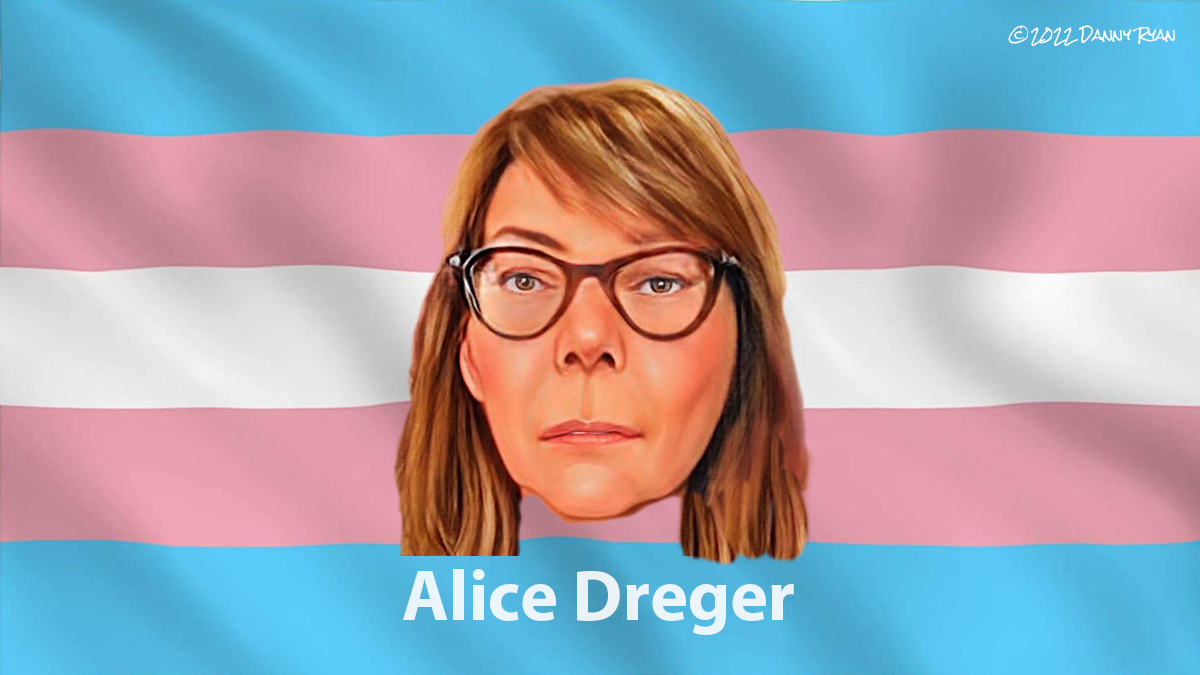
Alice Dreger is an American historian and self-styled “hermaphrodite monger” best known for exploiting people with variations of sex characteristics and promoting disease models to describe these traits. Dreger is a key historical figure in repathologizing intersex people through promoting the disease model “disorders of sex development.”
Dreger calls this community and their traits:
- “hermaphrodites” (i.e., “hermaphrodite monger” and Dreger’s 1998 book Hermaphrodites and the Medical Invention of Sex)
- “disorders of sex differentiation” (2005)
- “disorders of sex development” (2006 DSD Consortium)
Starting in 2006, Organisation Intersex International (OII), a decentralized global network of community organizations, condemned Dreger’s attempts to speak for the community. Since that time, most major intersex rights organizations have joined OII in criticizing Dreger’s disease models.
Background
See this biography for Dreger’s general background and this overview of Dreger’s overlapping anti-transgender activism. Dreger was one of the first members named to the so-called intellectual dark web, described as a “gateway to the far right.”
Dreger attended Indiana University for graduate work in history. Dreger’s 1995 doctoral dissertation was titled Doubtful Sex: Cases and Concepts of Hermaphroditism in France and Britain, 1868–1915. Dreger’s dissertation advisors were Ann G. Carmichael and Frederick B. Churchill. Dreger’s 1995 dissertation was developed into the 1998 book Hermaphrodites and the Medical Invention of Sex.
In the course of researching, Dreger came into contact with “Cheryl Chase” (Bo Laurent) and hoaxer “Kiira Triea” (Denise Magner), both of whom claimed to be community activists who had variations of sex characteristics. In 1993 Laurent founded Intersex Society of North America (ISNA) and worked closely with Dreger for many years, to the point that Laurent and spouse called themselves “Kepler’s uncles,” a reference to Dreger’s child. Over time ISNA came largely under Dreger’s control and was administered from Dreger’s Michigan address. At some point, Dreger and Laurent apparently had a falling out.
In the 1990s, researchers began proposing the term “disorders of sexual differentiation.” Groups like the Network on Psychosexual Differentiation met to discuss strategies for promoting this disease model in 2003 and 2004.
Dreger’s disease model

Dreger is a key promoter of describing sex minorities as disordered and diseased. Dreger proposed two disease models:
- “disorders of sexual differentiation” (2005)
- “disorders of sex development” (2006)
In August 2005 Dreger was principal author of a paper (along with spouse Aron Sousa and friend Bo Laurent) titled “Changing the Nomenclature/Taxonomy for Intersex: A Scientific and Clinical Rationale.” That paper recommends “the umbrella term ‘disorders of sexual differentiation’.” Dreger claimed:
Such an approach would have the salutary effects of improving patient and physician understanding and reducing the biases that are inherent in the use of the current language of ‘hermaphroditism’.
Dreger (2005)
In 2006, Dreger began promoting the alternate term “disorders of sex development” to describe the community. Dreger solicited grant funding and created the “Consortium on the Management of Disorders of Sex Development,” where Dreger was Project Coordinator and Editor. Dreger then launched a website called DSD Guidelines. The site promoted two documents published by the “consortium”:
- Clinical Guidelines for the Management of Disorders of Sex Development in Childhood (©2006 ISNA)
- Handbook for Parents (©2006 ISNA, Funded by The California Endowment and Arcus Foundation
Community members immediately objected to describing sex trait diversity as “disorders,” but Dreger insisted the term “isn’t terribly stigmatizing.” In a since-deleted post on the Intersex Society of North America (ISNA) website, Dreger defended this bad idea:
We realize, of course, that any terminology including the word “disorder” can be construed as pejorative. We’d also like to emphasize that we use the abbreviated form of DSD whenever possible. Explaining why this is important, Alice Dreger writes, “we find that, when accompanied by an explanation of what we mean, DSD isn’t terribly stigmatizing. And an important point: the acronym DSD is very useful—and thus, the acronym should be favored over the spelled-out term— because as an abbreviation we don’t focus on ‘disorder’.” We explain what we mean, and then use the term “DSDs.” Thus, we recognize that this is not a perfect term, but we hope ISNA’s supporters and allies will understand that it’s helping us enact real change in medical care.
ISNA blog (September 30, 2006)
http://www.isna.org/node/1028 [deleted the following day, restored in 2021]
Origins of Dreger’s disease model
Curtis Hinkle at OII led the community response to Dreger’s attempts to pathologize the whole community. Hinkle and the editorial team at OII traced Dreger’s activism to Penn State’s Network on Psychosexual Differentiation, funded by the National Institute of Child Health and Human Development (NICHD).
1) J Michael Bailey is a central figure in the Network on Psychosexual Differentiation at Penn State which resurrected the Disorder terminology in a psychosexual context. He spoke on different occasions at their meetings specifically on intersex and helped formulate their mission which includes the following:
“Develop or refine animal paradigms that model and help to explain the genetic, neuroendocrine, and social processes underlying both normal sex-typed behaviors and pathological behaviors observed in individuals with intersex conditions or gender-atypical behavior.”
NSD (2003)
http://nichdnet.psych.psu.edu/aims.html [archive]
In what has become known as the “Dregerian narrative,” Dreger attacked these critics in an email the following day. Those critics include Curtis Hinkle, co-founder of global network OII and in Dreger’s mind, a key ISNA “competitor.” It also includes Andrea James (author of this site and profile). Dreger had become enraged after failing to stop James from speaking at Northwestern University earlier that year. James vowed to discredit “disorders of sex development” as part of work discrediting disease models of gender identity and expression.
From: “Alice Dreger, Ph.D.”
To: [recipients’ names removed]
Subject: DSD terminology
Date: Sun, 1 Oct 2006 09:58:56 -0400Folks,
I hope your intersex rights work is going well as I write. As always, I personally appreciate what you’re doing to help build a better world for intersex children and adults.
I see that Curtis Hinkle is up to his usual behavior, this time attacking me personally about the DSD terminology. I want you to know one thing, and then to make a suggestion.
The thing I want you to know is that I pissed off trans activist Andrea James (see http://www.alicedreger.com/in_fear), and as a result she decided she would try to attack me via attacking the DSD terminology. She told me this explicitly in an email on June 1, 2006. I quote: “I could care less about your kid and your sense of breeder entitlement. I am, however, going to do what I can to discredit your lame-ass DSD model. At least you got that part right.”
I also quote here from her email of May 27, 2006: “DSD is going to be your merm and ferm. You have made a spectacular misstep with this disease model, though still not as inept as Bailey’s. Can’t wait till you and DSD are discredited by intersex activists (e.g., the world outside ISNA) and top-tier ethicists (e.g., not you) looking at the bigger picture. Your one-issue advocacy is selling out a larger movement for the sake of expediency. Bad move, mommy.”
So besides sending me threats about my son, James has opted to team up with Curtis to achieve her aims. Hence her links to Curtis’s work on her general-attack site.
I want you to know this because I think a lot of intersex people are in danger of having their progressive energies sucked up by an offshoot of James’s attempts to irritate and discredit me, which are offshoots of her attempts to ruin other people.
That said, I do think it is definitely worth having productive discussions about the DSD terminology and when it is worth using, and I’m glad people are taking about it.
So my suggestion is this: When you’re engaged in discussions about this, PLEASE do not waste time discussing what I think or what I have said or anything else about me. Focus on what matters — intersex people and their well-being. It doesn’t matter what I think or say, except insofar as perhaps some people wish to know how I see the debate. What matters is how well people with intersex are.
So please try to keep the discussion focused on what really matters, and that way James won’t be harming the intersex community the way she has so tragically harmed the transgender community. (You won’t know about a lot of that harm, but I do, because since I spoke up, many trans people have written to me to tell me what she’s done to them. They are much too afraid–for obvious reasons–to speak publicly about what she’s done to them.)
As I talked about in my recent blog on the terminology (http://www.alicedreger.com/dsd), I would really like to see people try to direct their writing, speaking, and thinking energies towards engagement with those with real power. That is not Curtis Hinkle, or for that matter most other intersex activists, including me. That is the doctors and the parents who need our help understanding how to make things better and better. That’s why I spend the vast majority of my energy doing that kind of engagement and I encourage you to do the same, even as people whack at you (or your friends and allies) and try to distract you from your real work that I know you do so incredibly well–peer-support work, human rights work, educational work, medical reform work.
Please feel free to share this email with whomever you wish. I also welcome those of you who have my DSD resignation letter to go ahead and leak the rest of it; there’s nothing in there or any of the rest of my work that I’m not proud of. Indeed, I’ll attach the letter here so you all have the whole of it.
It has been my great privilege and honor to be so well advised and supported and led by you and your colleagues.
Best wishes,
AliceAlice Dreger, Ph.D.
Medical Humanities and Bioethics Program
Feinberg School of Medicine
Northwestern University
Hinkle wrote the definitive history of how Dreger was the central modern figure in pathologizing the community.
On November 12, 2007, Dreger gave a speech at the Kinsey Institute with the title “No Matter How You Slice It? Parsing Intersex.”
In the 2015 book Contesting Intersex: The Dubious Diagnosis, sociologist Georgiann Davis wrote the definitive account of how “DSD” ended up being part of a broader effort by medicine to reassert jurisdiction over intersex bodies.
Also in 2015, intersex rights group interACT completed a strategic planning process “that included significant attention to our use of DSD/intersex terminology.” The Board of Directors has approved the following new statement on language:
- interACT is opposed to any terminology that pathologizes people born with intersex traits.
- interACT is committed to avoiding the direct use of “disorder of sex development” language on our website and in other materials.
- interACT will on occasion use “difference of sex development” language strategically on a case-by-case basis when communicating with certain audiences such as some parents and doctors if deemed strategically necessary.
- interACT believes that people born with intersex traits ought to have the autonomy to use whichever term, or terms, they prefer when speaking about their own bodies and experiences and interACT will not prohibit, monitor or criticize the terminological preferences of people with intersex traits.
References
Hinkle, Curtis E. (September 26, 2006). Alice Dreger: Disorders of Sex Development. Organization Intersex International – USA
- Response from Curtis E. Hinkle, Founder OII
- Response from Michelle O’Brien, OII-UK
- Response from Sophia Siedlberg, OII-UK
- Response from Joëlle-Circé Laramée, OII-Canada
- Response from Vincent Guillot, OII – Francophone Europe
- Response from Edith Nagant, OII Belgium and Luxemburg
- Response from Marie-Noëlle Baechler, OII-Switzerland
- Dreger in Denial
- The Rhetorical castration of the Intersex community: An analysis of Alice Dreger’s Rhetoric of Power as applied to the DSD controversy
- http://oii-usa.blogspot.com/2006/09/alice-dreger-disorders-of-sex.html
- http://www.intersexualite.org/AliceDreger.html [archive]
- http://www.intersexualite.org/Dreger_Eugenics.html [archive]
- http://www.intersexualite.org/End.html [archive]
- http://www.intersexualite.org/DSD.html [archive]
- http://www.intersexualite.org/Circus_freaks.pdf [archive]
Publications by Dreger
“Alice Dreger, Hermaphrodite Monger” (September 27, 1994). unsubscribing. bionet.women-in-bio https://groups.google.com/g/bionet.women-in-bio/c/eaz3KUC3IHQ?pli=1
Dreger AD (1995). Doubtful sex: Cases and concepts of hermaphroditism in France and Britain, 1868-1915. [Ph.D Dissertation] Indiana University, Bloomington https://data.isiscb.org/isis/citation/CBB001565502/
Dreger, Alice (1998). Hermaphrodites and the Medical Invention of Sex. Harvard University Press, ISBN 978-0674001893
Dreger, Alice (2001). Board of Directors. Intersex Society of North America http://isna.org/about/board.html
Dreger AD, Chase C, Sousa A, Gruppuso PA, Frader J: Changing the nomenclature/taxonomy for intersex: a scientific and clinical rationale. J Pediatr Endocrinol Metab 18:729-733, 2005. https://doi.org/10.1515/JPEM.2005.18.8.729
Dreger, Alice (2006). About the Consortium on the Management of Disorders of Sex Development. https://dsdguidelines.org/about/consortium/
Dreger, Alice (September 28, 2006). Talking about What Matters. [later retitled Why “Disorders of Sex Development”? (On Language and Life).] https://alicedreger.com/dsd/
Resources
Blogspot (blogspot.com)
- Alice Dreger and Disorders of Sex Development
- alicedreger.blogspot.com
Alice Dreger (alicedreger.com)
- Public Lectures [archive]
- alicedreger.com/public_lectures.html
Intersex Society of North America (isna.org)
- Alice Dreger PhD, Board Chair (moved to emeritus status in 2006)
- isna.org/drupal/taxonomy/page/or/4
- isna.org/about/emeritus
DSD Guidelines (dsdguidelines.org)
Kepler’s Uncles (keplersuncles.com) [archive]
Note: In 2025, this site phased out AI illustrations after artist feedback. The previous illustration is here.
Was this helpful?
Support my work!