Donna Martina Cartwright (born October 4, 1946) is an American journalist and labor activist. Cartwright served as a copy editor for The New York Times for about 30 years, transitioning on the job in 1997 and retiring in 2006. Cartwright was named to the NLGJA LGBT Journalists Hall of Fame in 2014.
Background
Cartwright was born in Hackensack, New Jersey. Cartwright was also involved in creating and leading some of the most important trans rights organizations, including:
- Pride at Work
- New York Association for Gender Rights Advocacy (NYAGRA)
- Gender Rights Advocacy Association of New Jersey
- National Center for Transgender Equality
- TransEpiscopal
- Gender Rights Maryland
2000 media criticism
In 2000, Cartwright published a piece on how cis journalists were “Trivializing and Silencing Transgender People in Queer Media.” Cartwright wrote:
Transgender people, long marginalized in the gay and lesbian community and “written out” of its history, have been making a modest comeback in recent years. Many queer organizations routinely recognize our presence through the use of such phrases as “the GLBT community” to describe their missions or constituencies; that some of these “natives” might be capable of uttering words comprehensible to civilized people too often seems beyond the imagination of the “normalized” queer writer. Funny, gays and lesbians were seen in just such terms, not so long ago ….
Both this renewed visibility and its problems are reflected in a recent work of queer history, Dudley Clendinen and Adam Nagourney’s book. Out for Good: The Struggle to Build a Gay Rights Movement in America (Simon & Schuster, 1999) which covers the period from the late 1960’s until the late 1980’s.
Clendinen and Nagourney pay serious attention to many of the controversies over the place of trans- gender people in the queer movement over the last 30 years. Unfortunately, they treat us largely as a disempowered, voiceless “other,” passive objects of history rather than subjects.
DAYS OF FURY
By many accounts, 1973 was a difficult year for transgender queers: a rising tide of separatism in the lesbian/ feminist movements culmi- nated in an explosion of hatred and hysteria at the West Coast Lesbian Conference in Los Angeles in April; two months later, similar tensions erupted at the New York City Pride March.
Out for Good gives a compelling picture of these events: in L.A., Beth Elliott, a lesbian male-to-female transsexual, one of the conference organizers, was scheduled to sing as part of the conference’s opening ceremonies. She had been at the center of a bitter dispute over her transsexuality in the San Francisco chapter of the Daughters of Bilitis in late 1972.
Elliott is a fascinating figure; unfortunately, Clendinen and Nagourney seem oblivious to the pos- sibility that she might have had some- thing of value to contribute to their account. She is not quoted in Out for Good, and she says that they never interviewed her. By her own recollec- tion, she is the first “out” transsexual lesbian feminist. She transitioned at the age of 19, and soon thereafter was invited to join the Bay area Daughters of Bilitis chapter — at that point, the membership felt her transsexuality was not a disqualification.
“Wanting to make the freedom I was experiencing safer and available to more women,” she says, she began doing volunteer work at the chapter’s office. After several months, in the fall of 1971, she was elected Vice- President in a two-candidate race.
In the summer of ’72, however, trouble appeared in the form of lesbian separatists who began to press their perspective on the chapter as a whole. Tensions rose over various issues, from Elliott’s transsexuality to demands that the editor of the chap- ter newsletter be brought under offi- cial oversight. In the fall of that year, Elliott ran for re-election as Vice- President and was defeated in a cam- paign in which her transgender his- tory may have been a tacit issue. A few months later, in a separate vote, transsexuals were ruled ineligible for membership.
Out for Good skews history a bit in its account of the struggle in the San Francisco D.O.B. The book says Elliott’s “demand to be admitted into the San Francisco chapter of the Daughters of Bilitis had torn the group apart. The D.O.B. had devoted eighteen months to arguing about whether there was a place in the Daughters of Bilitis for a transsexual, before finally and bitterly voting ‘No’.”
But Elliott’s account, which is supported by a look at back copies of Sisters, the San Francisco D.O.B. ‘s magazine, is rather different. The battle took up at most a few months, not 18, and it was not over her “demand to be admitted,” but over her expulsion.
Perhaps Clendinen and Nagourney relied on the recollection of someone involved in the conflict, decades after the fact. All the more reason to have balanced their sources.
Cartwright added:
Not that this incident is exactly unknown territory for queer writers. Pat Califia, in her book Sex Changes (1997) quotes a member of the chap- ter who “had actually been present at the stormy meeting where [Elliott] was ousted …
“This doesn’t feel okay to me/ she said. ‘She worked harder than anyone else in D.O.B. She gave a lot to that organization. There was no good reason to kick her out. She hadn’t done anything wrong except be a transsexual. You wouldn’t believe some of the vile and vicious things other women said to her. And she just sat and listened to all of it, kept her dignity and answered them back without losing her temper or calling anybody names/”
A few months later, some of Elliott’s enemies in the San Francisco battle attended the conference in L. A. and created an uproar when she went on stage to sing. They demand- ed that she leave, the performance was brought to a halt, and the issue was debated for hours and ultimate- ly put to a vote.
Out for Good says there was a slim majority in favor of allowing Elliott to sing, but according to contemporary sources, the margin was overwhelming. Barbara McLean’s “Diary of a Mad Organizer” in the Lesbian Tide confer- ence issue says the women voted three to one to hear Elliott, while The Advocate (May 9, 1973) also calls the vote “overwhelming.” The separatists and some others in the audience walked out. According to The heritage of sexual sophistication.”
Advocate, Elliott later received a standing ovation from “most of the 1,200 women present.”
The next day, Robin Morgan, the writer and editor who later became a leading figure in the rightward drift of radical feminism, devoted part of her keynote address to a vicious, hateful attack on transgender women. In it, she suggested that we enjoy being harassed on the street (doesn’t that sound sickeningly familiar?), said that we “parody female oppression,” accused us of “leeching off women” and demanded that we be excluded from women’s space.
In a three-page account of the controversy at the conference. Out for Good quotes Morgan at length, and, somewhat more briefly, Jeanne Cordova (editorial coordinator of Lesbian Tide and an organizer of the conference) in Elliott’s defense. But neither Elliott nor any other transsex- ual is quoted; are we not up to speak- ing for ourselves? Elliott still lives in California, and eventually managed to become active again in the lesbian and leather communities; surely she might have been asked about her feelings concerning that day. And it is not exactly a daunting task to reach her; this writer managed it without great difficulty.
And Out for Good is not exactly neutral in tone. In addition to the factual errors and omissions, consider this description of Elliott: “She might have been the only woman in the room wearing a skirt or a gown — except for the fact that Beth Elliott wasn’t a woman. Beth Elliott was a preoperative transsexual, a man in the process of trying to become a woman, who, to complicate things, claimed to be a lesbian.”
At another point. Out for Good refers to “the near-riot that Beth Elliott had caused.” Well, it takes more than one person to cause a riot, and all Beth Elliott did was accept an invitation to sing. It was who she was, not what she said or did, that “caused” the near-riot.
Elliott, who was also a founding member of the Alice B. Toklas Democratic Club and who played an active role in the California Committee for Sexual Law Reform, paints an interesting picture of the early post-Stonewall queer move- ment. She says that many lesbians “judged individual transsexual women on the content of their character,” adding that “there were a lot of lesbians who had no interest in the legendary political correctness of the 1970’s.”
She also notes that many of the early-70’s lesbian communities were “very sex-positive … and the ‘sex purity’ movement never managed to control the lesbian community as a whole.
Tapestry article (2004)
In 2004, Dallas Denny published an exposé about “autogynephilia” activist Anne Lawrence in Transgender Tapestry. In it, Denny revealed that Cartwright had a similar inappropriate experience as I did with Lawrence. Cartwright and I were both hit on after being invited to Lawrence’s home under the pretense of taking vaginoplasty result photos for Lawrence’s consumer site:
James also describes an incident of alleged inappropriate boundary crossing in Lawrence’s photography of James’ genitals for Lawrence’s website www.annelawrence.com. James says Lawrence was inappropriately seductive while James had her clothes off. Lawrence denies this.
There’s more to the story. A year or so ago, Donna Cartwright, another transsexual woman, described to Tapestry an experience virtually identical to that reported by James. At that time we chose not to go forward with an unverified allegation. This allegation has now been substantiated in the form of James’ complaint. Lawrence denies this incident also.
For a more detailed account, see Anne Lawrence incident with Donna Cartwright.
References
Staff report (July 23, 2014). NLGJA names LGBT Journalist Hall of Famers, Excellence honorees. http://www.windycitymediagroup.com/lgbt/NLGJA-names-LGBT-Journalist-Hall-of-Famers-Excellence-honorees/48421.html
[Editors] (2004). Concerns about Dr. Anne Lawrence. Transgender Tapestry #105, p. 13. https://archive.org/details/transgendertapes1052unse/page/12
Resources
NLGJA (nlgja.org)
Digital Transgender Archive (digitaltransgenderarchive.net)
Solidarity (solidarity-us.org)
Healthcare NOW
–Donna Cartwright speech (2019) https://www.youtube.com/watch?v=5BWBm0k8Y0M
JoAnn Roberts (March 18, 1948–June 7, 2013) was an American publisher and activist whose important work bridges the transition from print to digital transgender resources.
Background
Roberts founded Creative Design Services (CDS) in 1985. Print magazines included:
- Ladylike
- International TransScript
Books included:
- Art & Illusion: A Guide to Crossdressing
- Vol. 1: Face & Hair
- Vol. 2: Fashion & Style
- The Transsexual’s Survival Guide to Transition & Beyond
- Volume 2: for Family, Friends, & Employers
- Coping with Crossdressing: Tools & Strategies for Partners
Roberts also produced instructional videos as well as social events like Paradise in the Poconos and Beauty And The Beach.
Roberts co-founded the Renaissance Education Association, the National Transgender Advocacy Coalition, the Congress of Transgender Organizations, the Transgender Alliance for Community, and GenderPac, and served an important role in the second International Congress on Crossdressing, Sex, and Gender.
In 1991, Roberts authored the Gender Bill of Rights.
In 1995 Roberts began developing several websites, first via CDS. then via 3-D Communications, Inc. with Jamie Faye Fenton and Angela Gardner from 1996 to 2006. Roberts absorbed all of the assets back into CDS in 2006.
- cdspub.com
- 3dcom.com
- transgender.org
- tgforum.com
Roberts died of lung cancer in 2013 and was posthumously honored with a Virginia Prince Award that year.
References
Roberts, JoAnn (1990). A Bill of Gender Rights. [archive]
Resources
Creative Design Services (cdspub.com)
Jami Kathleen Taylor is an American political scientist who has published on the transgender rights movement.
Background
Taylor earned a Bachelor of Arts in Economics, then a Masters in Public Administration from Old Dominion University in 2001. She then earned a Masters in Library Science at University of North Carolina at Greensboro in 2005 before earning a PhD in Public Administration from North Carolina State University in 2008.
Books
The Remarkable Rise of Transgender Rights (2018). Jami K. Taylor, Daniel C. Lewis, and Donald P. Haider-Markel. University of Michigan Press, ASIN B07HNY8CYD
Transgender Rights and Politics: Groups, Issue Framing, and Policy Adoption (2014). Jami K. Taylor and Donald Haider-Markel, eds. University of Michigan Press, ASIN B00ZYNBR5K
Resources
Linkedin: jamitaylorva
University of Toledo (utoledo.edu)
Roberta Angela Dee (October 31, 1950–March 13, 2003) was an American author and transgender rights activist. A longtime critic of sexologists Ray Blanchard and Anne Lawrence for their promotion of the disease “autogynephilia,” Dee was the journalist who broke the story of Lawrence’s unconsented genital examination of an unconscious Ethiopian patient during a surgical procedure. The incident led to Lawrence’s resignation as an anesthesiologist.
Background
Dee was born in Brooklyn, New York, grew up in Long Island, and lived in Atlanta before becoming a resident of Augusta, Georgia. She had a journalism degree. Her writing was published widely, and she was founder of the Women on the Net (WON) website, an early online resource for women of color. Her work includes:
- novels for Reluctant Press
- Roberta Dee: TS Girlfriend
- Roberta & Ren
- Sasha
- Roberta, a Lesbian Transsexual
- The Business of Being a Woman
- erotica for The Gay Café Library
- columns for print periodical The Transvestian
- columns for Roberta Angela Dee’s Haven on The Transgender Guide
Lawrence exposé (2002)
On October 10, 2002, Dee published the following post to soc.support.transgendered. It included the November 20, 1997 letter concluding the Washington State investigation and the 2-page Activity Report summarizing the case. While Dee says the patient was a minor, the documentation does not support that assumption. The patient was anesthetized by Lawrence prior to a hysterectomy, and the surgeon told Lawrence that the patient’s genitals appeared that way due to aging.
File on Anne A. Lawrence, M.D.
Dear Members:
I am in receipt of the document from the State of Washington, Department of Health, concerning the allegations that Anne A. Lawrence, MD, had, inappropriately examined a female minor. Of the 10 page document provided to me, I have reproduced the most pertinent three pages as text.
Appendix G indicates that Anne Lawrence plea bargained in order to avoid a complete investigation. This, in my humble opinion, is not indicative of someone who is innocent.
If a charge of sexual impropriety had been directed at me, I would seek a thorough investigation to clear my name and remove any suspicion. Why would an innocent person do any less?
Lawrence, at one point, had two attorneys defending her. I doubt that the little girl’s parents could afford the ensuing legal battle. Consequently, Lawrence is cleared by default.
Each of us, I’m sure, will reach his or her own conclusions. However, I must say that the activities do not sit well with me. I’ve seen this kind of thing before. A dirty doctor walks away unscathed but an innocent child, though not physically harmed, is emotionally scarred for life.
With Kind Regards,
Roberta Angela Dee
PS If anyone suspects that I might have doctored the document or that I omitted any pertinent information, the address is provided and you may request a copy of the original document.
STATE OF WASHINGTON
DEPARTMENT OF HEALTH
1300 SE Quince Street · P.O. Box 47866 · Olympia, WA 98504-7866
Full Lawrence file (2003)
Following Dee’s exposé, I requested the full file from the state to confirm her transcription independently. Dee’s version was not redacted and included some material that was removed in the version I received upon request in 2003. Among the notable changes:
05-22-97 Call from Lee Norman. Lawrence resigned. Reason threat of adverse action. She plea bargained to stave off investigation. Unauthorized exam of pateint. [… redacted* …] The patient was not harmed. Question of moral turpitude.
* Dee’s version said the edited line about Lawrence said: “Respondent has been having bizarre behavior for a while.”
References
Dee, Roberta Angela (October 10, 2002). File on Anne A. Lawrence, M.D. soc.support.transgendered [via Google Groups archive]
Dee, Roberta Angela. The Myth of Autogynephilia. The Transgender Guide. http://www.tgguide.com/question/rad/autogynephilia.html
Roberts, Monica (February 8, 2007). Roberta Angela Dee. Transgriot. https://transgriot.blogspot.com/2007/02/roberta-angela-dee.html
Roberts, Monica (March 13, 2013). Happy Birthday, Roberta Angela Dee. Transgriot. https://transgriot.blogspot.com/2013/03/happy-birthday-roberta-angela-dee.html
Resources
The Transgender Guide (tgguide.com)
WON: Women on the Net (members.aol.com/aawon1)
Monica Katrice Roberts (May 4, 1962 – October 5, 2020) was an American journalist and transgender rights activist. Roberts was founding editor of the award-winning blog TransGriot.
Background
Roberts grew up in Houston, Texas, graduating from Jones High School in 1980 and University of Houston in 1984. Roberts was a United Airlines Customer Service Representative from 1987 to 2001.
Roberts’ writing appeared at the Bilerico Project, Ebony.com, The Huffington Post and the Advocate. Roberts began writing TransGriot as a column in 2004, then as a standalone blog in 2006.
Roberts was honored many times for this work:
- IFGE Trinity Award (2006)
- Virginia Prince Transgender Pioneer Award (2015)
- Phillips Brooks House Association’s Robert Coles Call of Service Award (2016)
- HRC John Walzel Equality Award (2017)
- GLAAD Media Awards (2016 and 2018)
- Out 100 (2019)
Roberts was critical of medical and religious leaders who are critical of the transgender rights movement, including Paul McHugh. Roberts also raised the voices of trans women of color who were important historical figures in online activism, including Roberta Angela Dee.
References
Schmidt, Samantha (October 9, 2020). Monica Roberts, a pioneering transgender activist and journalist from Houston, dies at 58. Washington Post https://www.texastribune.org/2020/10/09/monica-roberts-transgender-activist/
All Things Considered (October 9, 2020). Transgender Rights Advocate And Journalist Monica Roberts Dies At 58. NPR https://www.npr.org/2020/10/09/922375866/transgender-rights-advocate-and-journalist-monica-roberts-dies-at-58
Bote, Joshua (October 9, 2020). ‘A trailblazing voice’: Monica Roberts, influential trans journalist and activist, dies at 58. https://www.usatoday.com/story/news/nation/2020/10/09/trans-journalist-monica-roberts-founder-transgriot-dies/5939542002/
Guerra, Joey (October 8, 2020). Monica Roberts, a towering advocate for transgender rights in Houston and beyond, dies. Houston Chronicle https://www.houstonchronicle.com/life/features/article/Monica-Roberts-a-towering-advocate-for-15632154.php
Kurutz, Steven (October 13, 2020). Monica Roberts, Transgender Advocate and Journalist, Dies at 58. New York Times https://www.nytimes.com/2020/10/13/us/monica-roberts-dead.html
Shey, Brittanie (January 30, 2018). 8 Houston Women to Watch on Social Media. Houstonia Magazine https://www.houstoniamag.com/articles/2018/1/30/houston-women-social-media
Roberts, Monica (November 05, 2007). Why Is The Catholic Church Hatin’ On Transpeople? TransGriot. https://transgriot.blogspot.com/2007/11/why-is-catholic-church-hatin-on.html
Resources
TransGriot (transgriot.blogspot.com)
Wikipedia (en.wikipedia.org)
CFAIR (cfair.blogspot.com)
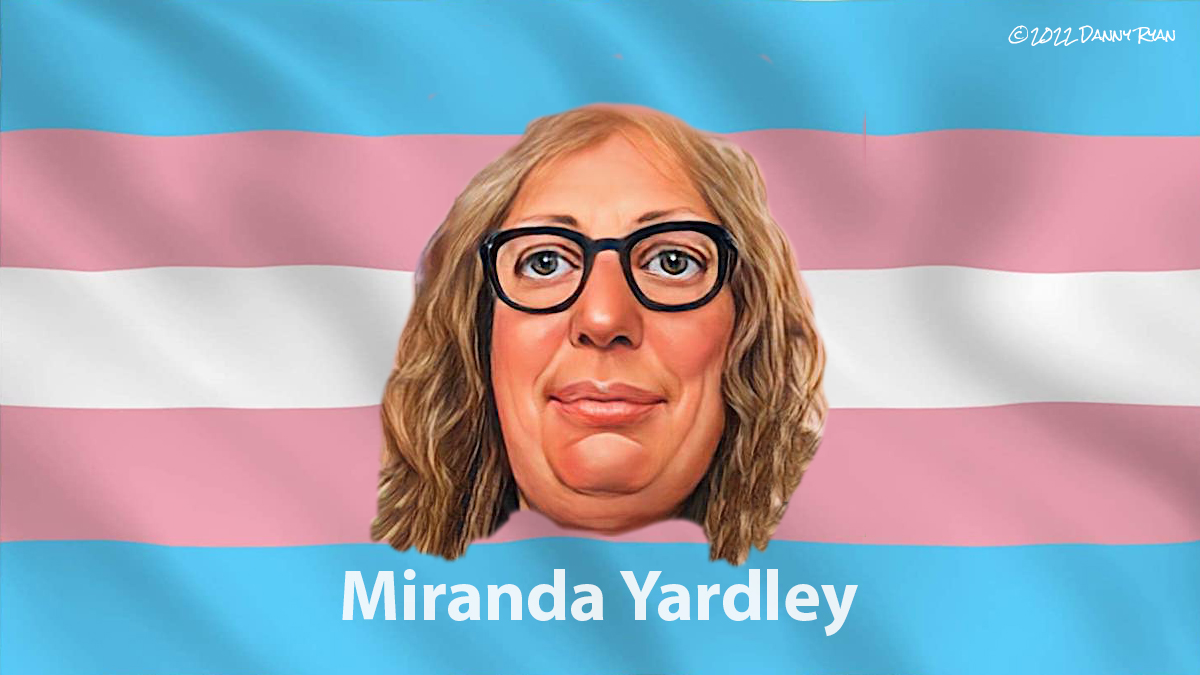
Miranda Yardley (born 1967) is a British accountant, publisher, and “autogynephilia” activist. Yardley identifies as transsexual and is a prominent conservative voice in the “gender critical” movement.
Background
Yardley earned a degree in accounting from Bangor University in 1990. Yardley started an accounting firm in 2000 and took over publishing music magazine Terrorizer in 2002 under the auspices of Dark Arts, Ltd. Yardley later added the titles Dominion and Sick Sounds.
In 2008, Yardley made a gender transition.
Activism
In 2014, Yardley became heavily involved in online fights about transgender politics, specifically rejecting the idea that trans women are women:
The gender critical approach establishes that “being a woman” is not a matter of an individual’s identity. Someone who is gender critical recognises that trans women are biologically male (and trans men are biologically female), that human beings are sexually dimorphic, that we are all subject to sex-based socialisation from birth. These are not value judgements; being biologically male is neither a good thing nor a bad thing. It is morally neutral.
This feminist approach views gender essentialism as the basis of women’s oppression, which as an extreme example would include violence (by men) against women. This is not to say that all men are violent, rather that male socialisation has violent aspects (like female socialisation has aspects that are, to quote a phrase, “sugar and spice and all things nice”). I therefore view gender as a harmful social construct which divides power unequally. I think of it as a hierarchy, with the sex-class “male” at the top.
Yardley (2014)
Media appearances
In 2018, Yardley was suspended from Twitter for saying Green Party spokesperson Aimee Challenor is a man. In April 2018 pro-trans cisgender activist Helen Islan brought a “transgender hate crime” complaint against Yardley that led to police involvement and a long investigation. The case was dropped in Yardley’s favor in March 2019.
Since that time, Yardley has been embraced by anti-transgender activists, appearing on their platforms, writing about trans community controversies, and working to change the UK’s 2004 Gender Recognition Act.
References
Yardley, Miranda (August 18, 2014). Kellie Maloney, Newsnight and the debate the transgender community refused to have. New Statesman https://www.newstatesman.com/world/2014/08/kellie-maloney-newsnight-and-debate-transgender-community-refused-have
Yardley, Miranda (August 30, 2016). What Autogynephilia is, and what is it not; a brief note. https://mirandayardley.com/en/what-autogynephilia-is-and-what-is-it-not-a-brief-note/
Yardley, Miranda (July 10, 2016). 17 Signs I Am An Autogynephile And Didn’t Know It. https://mirandayardley.com/en/17-signs-i-am-an-autogynephile-and-didnt-know-it/
Yardley, Miranda (July 10, 2016). Pornography And Autogynephilia In The Narratives Of Adult Transgender Males. https://mirandayardley.com/en/pornography-and-autogynephilia-in-the-narratives-of-adult-transgender-males/
Yardley, Miranda (June 17, 2017). A History of Autogynephilia. https://mirandayardley.com/en/a-history-of-autogynephilia/
Yardley, Miranda. Written evidence submitted by Miranda Yardley [1840] British Parliament https://committees.parliament.uk/writtenevidence/18025/pdf/
Resources
Miranda Yardley (mirandayardley.com)
Twitter (twitter.com)
Instagram (instagram.com)
Medium (medium.com)
YouTube (youtube.com)
Note: In 2025, this site phased out AI illustrations after artist feedback. The previous illustration is here.
K.J. Surkan (born February 6, 1969) is an American author and academic whose work focuses on gender.
Background
Surkan earned a bachelor’s degree from Smith College in 1991, then attended University of Minnesota, earning a master’s degree and Ph.D. in English.
Surkan’s 2006 article “Transsexuals Protest Academic Exploitation” summarized the turning point in the academic exploitation of transgender people.
Surkan began teaching at MIT in 2005.
Resources
Academia.edu (mit.academia.edu)
LinkedIn: KJ Surkan
Robin Elaine Wilson (born October 2, 1960) is an American journalist who spent most of her career at The Chronicle of Higher Education. Her coverage of the 2003 Northwestern University investigation into J. Michael Bailey following publication of The Man Who Would Be Queen was criticized by Bailey’s friend Alice Dreger.
Background
Wilson was born in Detroit, Michigan and earned a bachelor’s degree in liberal arts from College of Wooster in 1982. She joined The Chronicle in 1985 and wrote for them until 2017. She and her husband Darryl Ozias (born 1956) have two sons. She joined the Iowa State University wrestling program as Director of Operations in 2017, having previously volunteered for Head Coach Kevin Dresser when one of her sons wrestled for Dresser at Virginia Tech.
The Man Who Would Be Queen (2003)
In 2003 and 2004, Wilson wrote six articles about the book and the fallout for the Chronicle. The first, which Dreger characterizes as “gossipy,” came out shortly after Bailey’s vulgar misuse of gender diverse children at Stanford University. Wilson joined Bailey on on one of his voyeuristic sex tours (see Charlotte Allen) to the gay nightclub Circuit with Anjelica Kieltyka and the woman called “Juanita” in his book. Wilson describes Bailey as using medical gatekeeping to gain access to young attractive trans women: “As a psychologist, he has written letters they needed to get sex-reassignment surgery, and he has paid attention to them in ways most people don’t.”
In her 2008 article published by Kenneth Zucker, in the Archives of Sexual Behavior, Dreger singled out Wilson as the journalist who failed to cover the story objectively:
Wilson wrote these scandal reports as if she had just come upon the scene with no previous insider knowledge and no insider connections to use to figure out the truth behind this “controversy.” When I realized the strange role Wilson had played, I tried asking her and her editor why they hadn’t used her before-and-after-scandal positioning to ask deep questions about why Bailey’s relationships appeared, at least in public accounts, to have suddenly changed with these women. Wilson’s editor [Bill Horne] sent me back boilerplate: “We stand by the accuracy, and fairness, of Robin’s reporting and are not inclined to revisit decisions Robin and her editors made here with regard to what to include or exclude from those stories in 2003.” But I was left obsessing about an if: If Wilson had used her special journalistic position as someone who was there just before the mushroom cloud, she might have seen—right away—what I saw when years later I charted the journey.
Galileo’s Middle Finger (2015)
Dreger toned down her comments in the reprinted version in Galileo’s Middle Finger:
Now, maybe Wilson would have concluded that Conway had just educated all these women into understanding they had been abused. But if she had taken this or any other theory of what had changed the scene so dramatically, and then bothered to look into the actual charges, as I was finally doing years later, she might have seen them fall apart one by one. And then she could have reported that. Was Wilson a good liberal simply afraid to look as though she was defending a straight, politically incorrect sex researcher against a group of supposedly downtrodden trans women? Had Conway and James scared the crap out of her, as they seemed to scare everybody else? Or was the explanation simpler? Was it just that trying to figure out what the hell was really going on would have taken too much time and other resources?
References
Dreger, Alice (2015). Galileo’s Middle Finger.
Dreger, Alice (2008). The Controversy Surrounding The Man Who Would Be Queen. Archives of Sexual Behavior.
Wilson, Robin (September 3, 2016). Citing Safety Concerns, Northwestern U. Bans Tenured ‘Gadfly’ Professor From Campus.
Wilson, Robin (December 10, 2004). Northwestern U. Will Not Reveal Results of Investigation Into Sex Researcher.
Wilson, Robin (December 1, 2004). Northwestern U. Concludes Investigation of Sex Researcher but Keeps Results Secret.
Wilson, Robin (December 12, 2003). Northwestern U. Psychologist Is Accused of Having Sex With Research Subject.
Wilson, Robin (July 25, 2003). Transsexual ‘Subjects’ Complain About Professor’s Research Methods.
Wilson, Robin (July 17, 2003). 2 Transsexual Women Say Professor Didn’t Tell Them They Were Research Subjects.
Wilson, Robin (June 20, 2003). ‘Dr. Sex.’
Resources
Chronicle of Higher Education (chronicle.com)
Iowa State Athletics (cyclones.com)
William Walter Horne, Jr. (born August 23, 1959) is an American journalist who was editor of the Chronicle of Higher Education from 2000 to 2007. Horne’s Chronicle coverage of the 2003 Northwestern University investigation into J. Michael Bailey following publication of The Man Who Would Be Queen was criticized by Bailey’s friend Alice Dreger in both the Archives of Sexual Behavior and Galileo’s Middle Finger.
Background
Horne earned a bachelor’s degree in communications from Cornell University and a law degree from Albany Law School of Union University in 1984. He was admitted to the New York Bar in 1985 and practiced for several years before going into journalism, where he has published with bylines including William W. Horne and Bill Horne.
Horne joined the Chronicle in 2000 as Deputy Managing Editor, rising to editor from 2004 to 2007. He then held editor positions at World History Group from 2008 to 2013, then joined AARP in 2014 as Executive Editor of their magazine. His wife Kathleen “Kathy” Broadbent Horne is also a lawyer.
The Man Who Would Be Queen (2003)
Chronicle staffer Robin Wilson wrote six articles covering the controversy, and Dreger was critical of the coverage, citing her correspondence with Horne:
When I realized the strange role Wilson had played, I tried asking her and her editor why they hadn’t used her before-and-after-scandal positioning to ask deep questions about why Bailey’s relationships appeared, at least in public accounts, to have suddenly changed with these women. Wilson’s editor sent me back boilerplate: “We stand by the accuracy, and fairness, of Robin’s reporting and are not inclined to revisit decisions Robin and her editors made here with regard to what to include or exclude from those stories in 2003.”
References
Dreger, Alice (2008). The Controversy Surrounding The Man Who Would Be Queen: A Case History of the Politics of Science, Identity, and Sex in the Internet Age. Archives of Sexual Behavior. https://doi.org/10.1007/s10508-007-9301-1
Dreger, Alice (2015). Galileo’s Middle Finger: Heretics, Activists, and One Scholar’s Search for Justice. Penguin Books ISBN 978-0143108115
Resources
Muckrack (muckrack.com)
Christine McGinn is an American plastic surgeon based in Pennsylvania.
Background
Christine Noelle McGinn was born May 31, 1969 and grew up in Bucks County, Pennsylvania. McGinn earned a bachelor’s degree in biology from Moravian College in 1991, followed by a medical degree from Philadelphia College of Osteopathic Medicine in 1995. McGinn then joined the United States Navy, Naval Aerospace Medicine Institute US Naval Flight Surgery Training.
McGinn made a gender transition starting in 2000.
McGinn was a consultand on the 2015 film The Danish Girl and has appeared on Dr. Oz, CNN with Anderson Cooper, IAm Jazz, and The Oprah Winfrey Show.
Memberships:
- American Medical Association
- American Osteopathic Association
- American College of Osteopathic Surgeons
- Society of United States Naval Flight Surgeons
- Aerospace Medical Association
- World Professional Association for Transgender Health
- Gay and Lesbian Medical Association
- Society for the Scientific Study of Sex
- Association of Sex Educators, Counselors and Therapists
References
Savana, Freda (March 5, 2016). Dr. Christine McGinn brings unique experience to Papillion Gender Wellness Center. PhillyBurbs https://www.phillyburbs.com/story/news/2016/03/06/dr-christine-mcginn-brings-unique/18154898007/
Perez, Medardo (July 31, 2017). Ex-Navy Surgeon Promises Free Surgery for Transgender Troops. NBC News https://www.nbcnews.com/feature/nbc-out/ex-navy-surgeon-promises-free-surgery-transgender-troops-n788126
Resources
Papillon Gender Wellness Center (drchristinemcginn.com)